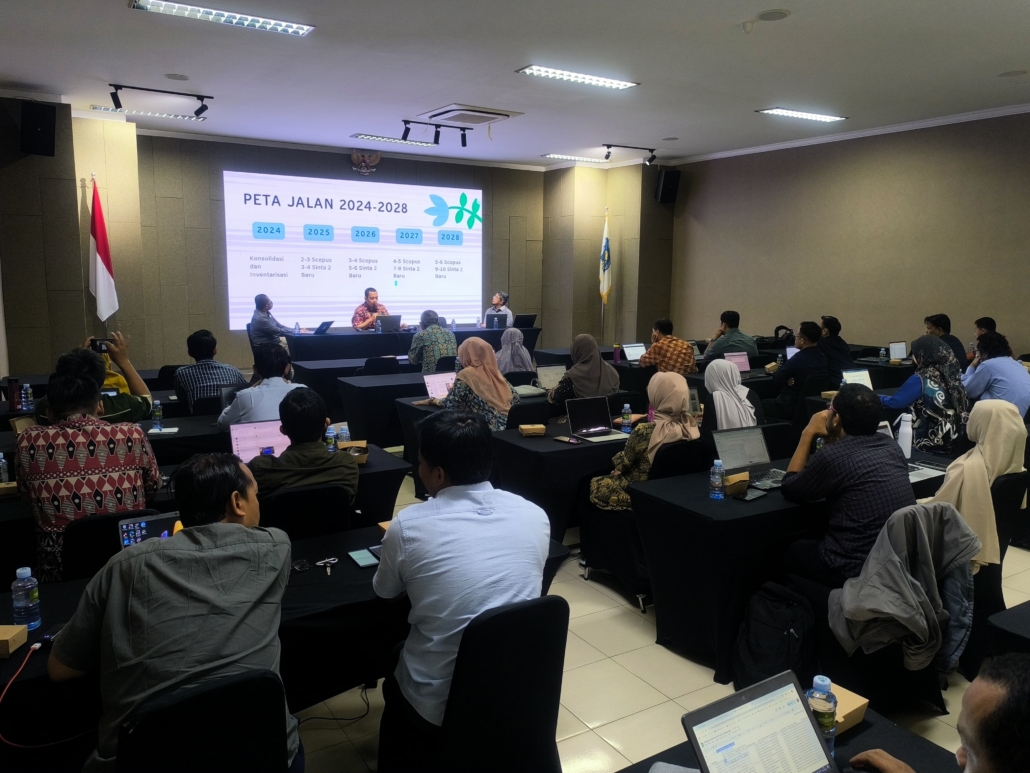
The Indonesian Islamic University (UII) is committed to continuously improving the quality of scientific publications through the implementation of appropriate journal management standards. To support better journal management, the Directorate of Research and Community Service (DPPM) UII held a workshop titled “Workshop on Journal Management for Journal Managers at UII” on Wednesday, October 30, 2024, in the Datar Meeting Room of the Prof. Dr. Sardjito Building, UII.
Ir. Eko Siswoyo, S.T., M.Sc.ES., Ph.D., the director of DPPM UII, expressed in his opening speech the hope that this workshop would provide participants with a better understanding and skills to improve journal management quality in accordance with national and international accreditation standards. This initiative aims to assist journal managers in maintaining the quality of scientific content, management aspects, data security, editorial management, and the technical skills required for scientific publication management.
During the workshop, participants received materials related to the management of scientific journals, technical skills in editorial management, and strategies for improving journal quality presented by the Head of the UII Journal House Team, Yuli Andriansyah, S.E., M.S.I. There were also materials on data security management presented by Ari Sujarwo, S.Kom., M.I.T. (Hons), Head of the Operations Division of UII’s Information System Agency.
In his presentation, Yuli Andriansyah emphasized the importance of collaboration among key roles, ranging from Editor-in-Chief to Language Editor. Several UII journals have also subscribed to specialized tools such as Scopus and ChatGPT to support editorial performance. This reflects UII’s commitment to producing high-quality publications.
According to Yuli Andriansyah, to obtain Scopus indexing, journals must meet several criteria, including peer-reviewed content, regular publication, and the presence of a publication ethics statement. Another distinctive feature is that the title and abstract of the articles must be presented in English. The journal Millah: Journal of Religious Studies is an example that has met these criteria. With the implementation of a strict peer-review process and support from the Open Journal Systems (OJS) platform, Millah is committed to enhancing academic publication quality.
Meanwhile, Ari Sujarwo elaborated on specific journal services available at journal.uii.ac.id, the use of the Open Journal System (OJS) version 3, Cyber Security Maturity (CSM) information security standards from BSSN, as well as UII’s firewall and WAF from CloudFlare. Ari also highlighted three main elements in information security management for journals: confidentiality, where information should only be accessible to relevant parties (authors, reviewers, editors); integrity, emphasizing the validity of data sources and/or information; and availability, which is closely related to the ease of accessing papers/journals and the website.
In conclusion, the standardization of journal management not only brings UII closer to Scopus indexing but also supports international recognition of its academic contributions.
DPPM UII aims that after participating in the workshop, journal managers will understand the standards for managing scientific journals, apply data security management, formulate targeted quality strategies, and be able to identify and resolve operational obstacles in journal management.
With this initiative, UII hopes to maintain and enhance the position of the journals managed within the campus, thereby contributing more significantly to the development of science and technology in Indonesia.
Announcement of Registration and Payment Dispensation for Community Service Program (KKN) Batch 70 Even Semester Academic Year 2024/2025
ANNOUNCEMENT
No: 968/Dir.DPPM/80/DPPM/XII/2024
Subject:
Announcement of Registration and Payment Dispensation for
Community Service Program (KKN) Batch 70
Even Semester Academic Year 2024/2025
It is hereby announced to all UII students that there will be a dispensation for the registration and payment of the Community Service Program (KKN) Batch 70 for the Even Semester of the Academic Year 2024/2025. The registration and payment dispensation will be held on Thursday, December 5, 2024, to Friday, December 6, 2024.
Students who have registered but have not yet made their payment are still required to complete the registration process, as the previous payment invoices have expired.
We thank you for your attention.
Yogyakarta, 3 December, 2024
Director of DPPM
(Ir. Eko Siswoyo, S.T., M.Sc.ES., Ph.D.)
Pengumuman Dispensasi Pendaftaran dan Pembayaran KKN Angkatan 70 Semester Genap TA 2024/2025
PENGUMUMAN
No:968/Dir.DPPM/80/DPPM/XII/2024
Tentang:
Pengumuman Dispensasi Pendaftaran dan Pembayaran
KKN Angkatan 70 Semester Genap
TA 2024/2025
Diumumkan kepada mahasiswa UII bahwa dispensasi pendaftaran dan pembayaran KKN angkatan 70 Semester Genap TA 2024/2025. Dispensasi pendaftaran dan pembayaran KKN akan dilaksanakan pada hari Kamis, 5 Desember 2024 s/d Jum’at, 6 Desember 2024.
Bagi mahasiswa yang sudah mendaftar tetapi belum melakukan pembayaran, tetap melakukan proses pendaftaran karena tagihan sudah kedaluwarsa.
Atas perhatiannya kami ucapkan terimakasih.
Yogyakarta, 3 Desember 2024
Direktur
Ir. Eko Siswoyo, S.T., M.Sc.ES., Ph.D.
Journal Management Workshop at UII: Enhancing the Quality of Scientific Publications
The Indonesian Islamic University (UII) is committed to continuously improving the quality of scientific publications through the implementation of appropriate journal management standards. To support better journal management, the Directorate of Research and Community Service (DPPM) UII held a workshop titled “Workshop on Journal Management for Journal Managers at UII” on Wednesday, October 30, 2024, in the Datar Meeting Room of the Prof. Dr. Sardjito Building, UII.
Ir. Eko Siswoyo, S.T., M.Sc.ES., Ph.D., the director of DPPM UII, expressed in his opening speech the hope that this workshop would provide participants with a better understanding and skills to improve journal management quality in accordance with national and international accreditation standards. This initiative aims to assist journal managers in maintaining the quality of scientific content, management aspects, data security, editorial management, and the technical skills required for scientific publication management.
During the workshop, participants received materials related to the management of scientific journals, technical skills in editorial management, and strategies for improving journal quality presented by the Head of the UII Journal House Team, Yuli Andriansyah, S.E., M.S.I. There were also materials on data security management presented by Ari Sujarwo, S.Kom., M.I.T. (Hons), Head of the Operations Division of UII’s Information System Agency.
In his presentation, Yuli Andriansyah emphasized the importance of collaboration among key roles, ranging from Editor-in-Chief to Language Editor. Several UII journals have also subscribed to specialized tools such as Scopus and ChatGPT to support editorial performance. This reflects UII’s commitment to producing high-quality publications.
According to Yuli Andriansyah, to obtain Scopus indexing, journals must meet several criteria, including peer-reviewed content, regular publication, and the presence of a publication ethics statement. Another distinctive feature is that the title and abstract of the articles must be presented in English. The journal Millah: Journal of Religious Studies is an example that has met these criteria. With the implementation of a strict peer-review process and support from the Open Journal Systems (OJS) platform, Millah is committed to enhancing academic publication quality.
Meanwhile, Ari Sujarwo elaborated on specific journal services available at journal.uii.ac.id, the use of the Open Journal System (OJS) version 3, Cyber Security Maturity (CSM) information security standards from BSSN, as well as UII’s firewall and WAF from CloudFlare. Ari also highlighted three main elements in information security management for journals: confidentiality, where information should only be accessible to relevant parties (authors, reviewers, editors); integrity, emphasizing the validity of data sources and/or information; and availability, which is closely related to the ease of accessing papers/journals and the website.
In conclusion, the standardization of journal management not only brings UII closer to Scopus indexing but also supports international recognition of its academic contributions.
DPPM UII aims that after participating in the workshop, journal managers will understand the standards for managing scientific journals, apply data security management, formulate targeted quality strategies, and be able to identify and resolve operational obstacles in journal management.
With this initiative, UII hopes to maintain and enhance the position of the journals managed within the campus, thereby contributing more significantly to the development of science and technology in Indonesia.
Dokumentasi Prosiding Seminar Nasional 2024
Workshop Pengelolaan Jurnal di UII: Meningkatkan Kualitas Publikasi Ilmiah
Yogyakarta, 30 Oktober 2024 – Universitas Islam Indonesia (UII) berkomitmen untuk terus meningkatkan kualitas publikasi ilmiah melalui penerapan standar pengelolaan jurnal yang tepat. Dalam rangka mendukung pengelolaan jurnal yang lebih baik, Direktorat Penelitian dan Pengabdian Masyarakat (DPPM) UII menggelar workshop bertajuk “Workshop Pengelolaan Jurnal bagi Pengelola Jurnal di UII”, Rabu, 30 Oktober 2024, di Ruang Sidang Datar Gedung Prof. Dr. Sardjito, UII
Ir. Eko Siswoyo, S.T., M.Sc.ES., Ph.D selaku direktur DPPM UII dalam sambutannya berharap agar melalui workshop tersebut peserta memperoleh pemahaman dan keterampilan yang lebih baik dalam meningkatkan kualitas pengelolaan jurnal sesuai dengan standar akreditasi nasional dan internasional, dapat membantu pengelola jurnal dalam hal menjaga mutu konten ilmiah, aspek manajemen, keamanan data, pengelolaan editorial serta keterampilan teknis yang dibutuhkan dalam pengelolaan publikasi ilmiah.
Dalam workshop ini, peserta mendapatkan materi terkait manajemen pengelolaan jurnal ilmiah, keterampilan teknis dalam pengelolaan editorial, dan metode untuk menyusun strategi peningkatan kualitas jurnal yang disampaikan oleh Ketua Tim Rumah Jurnal UII, Yuli Andriansyah, S.E., M.S.I., dan juga materi terkait manajemen keamanan data yang disampaikan oleh Ari Sujarwo, S.Kom., M.I.T. (Hons), Kepala Bidang Operasi Badan Sistem Informasi UII.
Dalam paparannya, Yuli Andriansyah juga menekankan pentingnya kolaborasi dengan berbagai peran kunci, mulai dari Editor-in-Chief hingga Language Editor. Beberapa jurnal UII juga berlangganan alat khusus seperti Scopus dan ChatGPT untuk mendukung kinerja editorial. Hal ini mencerminkan komitmen UII dalam menghasilkan publikasi berkualitas.
Sementara untuk mendapatkan indeks Scopus, menurut Yuli Andriansyah jurnal harus memenuhi beberapa kriteria, termasuk konten peer-reviewed, penerbitan rutin, dan kehadiran pernyataan etika publikasi. Ciri khas lain adalah judul dan abstrak artikel harus disajikan dalam bahasa Inggris. Jurnal Millah: Journal of Religious Studies merupakan contoh yang telah memenuhi kriteria tersebut. Dengan penerapan proses peer-review ketat dan dukungan platform Open Journal Systems (OJS), Millah berkomitmen untuk meningkatkan kualitas publikasi akademik.
Sedangkan Ari Sujarwo banyak menjelaskan tentang layanan jurnal khusus melalui journal.uii.ac.id, penggunaan mesin web Open Journal System (OJS) versi 3, standar keamanan informasi Cyber Security Maturity (CSM) dari BSSN dan juga mesin firewall UII dan WAF dari CloudFlare. Ari juga menyampaikan 3 unsur utama dalam manajemen keamanan informasi junral , yakni confidentiality dimana informasi hanya boleh dibaca oleh pihak-pihak berkepentingan (author, reviewer, editor), integrity yang menekankan validitas sumber data dan atau informasi, serta availability yang berkait erat dengan kemudahan dalam mengakses makalah/jurnal dan website.
Pada akhirnya standarisasi pengelolaan jurnal ini tidak hanya mendekatkan UII pada indeks Scopus, tetapi juga mendukung pengakuan internasional terhadap kontribusi akademiknya.
DPPM UII menargetkan setelah mengikuti workshop, pengelola jurnal diharapkan dapat memahami standar pengelolaan jurnal ilmiah, menerapkan manajemen keamanan data, menyusun strategi kualitas yang terarah, dan mampu mengidentifikasi serta menyelesaikan kendala operasional dalam pengelolaan jurnal.
Dengan inisiatif ini, UII berharap dapat mempertahankan dan meningkatkan posisi jurnal-jurnal yang dikelola di lingkungan kampus, sehingga dapat berkontribusi lebih besar bagi perkembangan ilmu pengetahuan dan teknologi di Indonesia (WHP).
Workshop Pengelolaan Jurnal Bagi Pengelola Jurnal di Universitas Islam Indonesia
SEMINAR NASIONAL DPPM UII: PENGEMBANGAN ENERGI BARU DAN TERBARUKAN UNTUK LINGKUNGAN BERKELANJUTAN
KALIURANG (DPPM UII). Indonesia masih menghadapi tantangan besar dalam mengelola sampah, terutama karena sebagian besar sistem pengelolaannya masih bergantung pada tempat pembuangan akhir (TPA) terbuka. TPA ini menjadi salah satu sumber utama emisi gas rumah kaca, khususnya metana, yang dampaknya terhadap pemanasan global 28 kali lebih kuat dibandingkan karbon dioksida. Dalam Seminar Nasional yang digelar oleh Direktorat Penelitian dan Pengabdian Masyarakat (DPPM) Universitas Islam Indonesia (UII) pada 16 Oktober 2024 di Gedung K.H.A. Wahid Hasyim, Dr. Novrizal Taher selaku Direktur Pengelolaan Sampah dari Kementerian Lingkungan Hidup dan Kehutanan (KLHK), menyampaikan bahwa untuk mengatasi masalah tersebut Indonesia telah menetapkan Kebijakan Strategi Nasional (Jakstranas) untuk menargetkan pengurangan sampah sebesar 30% dan penanganan sampah 70% pada 2025. Namun, data 2023 menunjukkan bahwa pengurangan sampah baru mencapai 13,67%, sedangkan penanganan sampah berada di angka 48,12%, yang masih jauh dari target yang diharapkan.
Salah satu fokus pemerintah untuk mencapai target pengurangan emisi gas rumah kaca adalah melalui komitmen dalam kerangka Paris Agreement. Indonesia telah menyusun Nationally Determined Contributions (NDC), yang bertujuan untuk mengurangi emisi gas rumah kaca sebesar 31,9% hingga 43,2% pada tahun 2030. Dalam upaya ini, pemerintah mendorong penerapan teknologi Waste-to-Energy (WTE) dan sistem daur ulang berkelanjutan sebagai strategi utama. Teknologi WTE yang telah diterapkan di beberapa kota besar, seperti Surabaya dan Solo, mengolah sampah menjadi sumber energi listrik. Diharapkan, langkah ini dapat memperbaiki pengelolaan sampah secara signifikan dan menurunkan emisi gas rumah kaca.
Pengelolaan sampah di Indonesia ke depan akan berfokus pada pendekatan ekonomi sirkular, di mana sampah diubah menjadi sumber energi dan bahan baku industri. Selain teknologi WTE, daur ulang juga diharapkan menjadi solusi yang lebih ramah lingkungan dalam jangka panjang. Pemerintah juga berupaya memperkuat regulasi terkait pemanfaatan teknologi hijau, terutama dalam mengurangi sampah plastik dari fase produksi hingga pengelolaan akhir. Dengan demikian, langkah-langkah ini diharapkan dapat mengurangi pencemaran lingkungan dan memperlambat perubahan iklim.
Selain Dr. Novrizal Taher, panitia juga mengundang Oki Muraza, Ph.D selaku Senior Vice President, Research & Technology Innovation, PT. Pertamina yang diwakili Ismal Gamar. Dalam paparannya Ismal Gamar menyampaikan komitmen Pertamina untuk beralih ke energi yang lebih berkelanjutan dan mencapai net zero emission. Pertamina telah menetapkan dua visi utama: optimalisasi bisnis yang sudah ada serta pengembangan bisnis rendah karbon. Salah satu upaya yang dilakukan adalah pemanfaatan gas untuk industri petrokimia dan pengembangan ekosistem biofuel. Pertamina bekerja sama dengan Universitas Mulawarman untuk memanfaatkan tanaman lokal, seperti sorgum dan singkong, dalam produksi bioetanol, dengan kemurnian mencapai 99,7%. Kolaborasi teknologi ini juga melibatkan Institut Teknologi Sepuluh Nopember (ITS) untuk mendukung proses pemurnian bioetanol, yang diuji pada kendaraan dengan campuran bioetanol 20% hingga 100%.
Selain itu, Pertamina juga mengeksplorasi sumber energi terbarukan dari minyak nabati tanaman seperti nyamplung dan kepuh untuk bahan bakar terbarukan. Pertamina terus mengembangkan energi alternatif lainnya, seperti tenaga angin, matahari, dan panas bumi. Transformasi digital juga diterapkan untuk memantau dan meningkatkan efisiensi operasional perusahaan, sejalan dengan komitmen mengurangi ketergantungan pada bahan bakar fosil.
Dengan berbagai inovasi teknologi dan kolaborasi dengan perguruan tinggi serta lembaga riset, Pertamina berharap program bioenergi ini tidak hanya berkontribusi pada ketahanan energi nasional, tetapi juga memberikan manfaat sosial dan ekonomi bagi masyarakat, terutama petani lokal yang terlibat dalam pengembangan bioenergi tersebut. Pertamina optimis, langkah-langkah ini akan menciptakan masa depan energi yang lebih bersih dan berkelanjutan bagi Indonesia.
Kegiatan yang dibuka secara langsung oleh Direktur DPPM UII, Ir. Eko Siswoyo, ST., M.Sc.Es., Ph.D mewakili Rektor UII usai penyampaian laporan dari ketua panitia penyelenggara yang juga Kepala Pusat Penelitian UII, Prof. Dr.rer.soc. Masduki, S.Ag., M.Si. tersebut diakhir dengan sesi tanya jawab dan presentasi makalah dari peserta seminar.
Keduanya pun berharap agar ajang seminar yang diselenggarakan secara rutin setiap tahun tidak hanya dimanfaatkan untuk berbagi ilmu semata namun juga untuk membangun jejaring atau berkolaborasi. (Wid)
Foto:
Suasanaa tanya jawab dalam Seminar Nasional “Pengembangan Energi Baru dan Terbarukan untuk Lingkungan Berkelanjutan” (Foto: Widodo)
NATIONAL SEMINAR DPPM UII: DEVELOPMENT OF NEW AND RENEWABLE ENERGY FOR A SUSTAINABLE ENVIRONMENT
KALIURANG (DPPM UII). Indonesia still faces significant challenges in waste management, particularly because most of its management systems still rely on open landfills (TPA). These landfills are a major source of greenhouse gas emissions, especially methane, which has a global warming impact 28 times stronger than carbon dioxide. At the National Seminar organized by the Research and Community Service Directorate (DPPM) of the Islamic University of Indonesia (UII) on October 16, 2024, at the K.H.A. Wahid Hasyim Building, Dr. Novrizal Taher, the Director of Waste Management from the Ministry of Environment and Forestry (KLHK), stated that to address this issue, Indonesia has established a National Strategy Policy (Jakstranas) targeting a 30% reduction in waste and 70% waste management by 2025. However, 2023 data shows that waste reduction has only reached 13.67%, while waste management stands at 48.12%, which is still far from the expected targets.
One of the government’s focuses to achieve greenhouse gas emission reduction targets is through commitments under the Paris Agreement framework. Indonesia has prepared Nationally Determined Contributions (NDC), aiming to reduce greenhouse gas emissions by 31.9% to 43.2% by 2030. In this effort, the government encourages the implementation of Waste-to-Energy (WTE) technology and sustainable recycling systems as a key strategy. WTE technology, which has been applied in several major cities such as Surabaya and Solo, processes waste into a source of electrical energy. It is hoped that this step can significantly improve waste management and reduce greenhouse gas emissions.
Future waste management in Indonesia will focus on a circular economy approach, where waste is transformed into energy sources and industrial raw materials. In addition to WTE technology, recycling is also expected to be a more environmentally friendly long-term solution. The government is also working to strengthen regulations related to the utilization of green technology, especially in reducing plastic waste from the production phase to final disposal. Thus, these steps are expected to reduce environmental pollution and slow down climate change.
In addition to Dr. Novrizal Taher, the committee also invited Oki Muraza, Ph.D, as the Senior Vice President of Research & Technology Innovation at PT. Pertamina, represented by Ismal Gamar. In his presentation, Ismal Gamar conveyed Pertamina’s commitment to transitioning to more sustainable energy and achieving net zero emissions. Pertamina has established two main visions: optimizing existing businesses and developing low-carbon businesses. One of the efforts made is the utilization of gas for the petrochemical industry and the development of a biofuel ecosystem. Pertamina collaborates with Mulawarman University to utilize local crops, such as sorghum and cassava, in bioethanol production, achieving a purity of 99.7%. This technological collaboration also involves Sepuluh Nopember Institute of Technology (ITS) to support the bioethanol purification process, which is tested on vehicles with a bioethanol blend of 20% to 100%.
In addition, Pertamina is also exploring renewable energy sources from vegetable oils of plants such as nyamplung and kepuh for renewable fuel. Pertamina continues to develop other alternative energies, such as wind, solar, and geothermal power. Digital transformation is also implemented to monitor and improve the company’s operational efficiency, in line with the commitment to reduce dependence on fossil fuels.
With various technological innovations and collaborations with universities and research institutions, Pertamina hopes this bioenergy program will not only contribute to national energy resilience but also provide social and economic benefits to the community, especially local farmers involved in the development of bioenergy. Pertamina is optimistic that these steps will create a cleaner and more sustainable energy future for Indonesia.
The event was officially opened by the Director of DPPM UII, Ir. Eko Siswoyo, ST., M.Sc.Es., Ph.D, representing the Rector of UII, after the report was delivered by the head of the organizing committee, who is also the Head of the UII Research Center, Prof. Dr.rer.soc. Masduki, S.Ag., M.Si. It concluded with a question-and-answer session and paper presentations from the seminar participants. Both hoped that the seminar, held regularly every year, would not only be used for sharing knowledge but also for building networks or collaborations.
(Wid)
Foto:
Question and answer atmosphere at the National Seminar “Development of New and Renewable Energy for a Sustainable Environment” (Foto: Widodo)
Announcement for KKN Registration of Batch 70 Even Semester Academic Year 2024/2025
ANNOUNCEMENT
No: 867/Dir.DPPM/80/DPPM/X/2024
Subject:
Announcement for Registration of KKN Batch 70 Even Semester Academic Year 2024/2025
It is announced to UII students who will participate in KKN Batch 70 Even Semester Academic Year 2024/2025, that the prerequisites for KKN Batch 70 are as follows:
The detailed process for KKN Batch 70 can be seen in the following flowchart:
Picture 1.0 Flowchart of the KKN Batch 70 Process
We thank you for your attention.
Yogyakarta, 14 October, 2024
Director of DPPM
(Signature)
Pengumuman Pendaftaran KKN Angkatan 70 Semester Genap TA 2024/2025
PENGUMUMAN
No:867/Dir.DPPM/80/DPPM/X/2024
Tentang:
Pengumuman Pendaftaran KKN Angkatan 70 Semester Genap TA 2024/2025
Diumumkan kepada mahasiswa UII yang akan mengikuti KKN angkatan 70 Semester Genap TA 2024/2025, bahwa prasyarat KKN angkatan 70 adalah sebagai berikut:
Selanjutnya rangkaian proses KKN angkatan 70 dapat dilihat dalam diagram alir berikut ini:
Gambar 1. 0 diagram alir proses KKN angkatan 70
Atas perhatiannya kami ucapkan terimakasih.
Yogyakarta, 14 Oktober 2024
Direktur
Ir. Eko Siswoyo, S.T., M.Sc.ES., Ph.D.