(Sleman 9/1) – Referring to the report by the Meteorology, Climatology, and Geophysics Agency (BMKG) of D.I. Yogyakarta, the rainy season began in October, with the peak expected in December 2022, January 2023, and February 2023, generally predicted to peak in February 2023 (Karnawati, 2022). The high rainfall has led to rainwater flooding in the Al-Muhajirin Mosque Complex area, Tiyasan, Condongcatur Village, Depok District, Sleman, D.I. Yogyakarta. This flooding is caused by the high and evenly distributed rainfall intensity in Sleman. Additionally, the concrete paving of village roads and residential yards in recent years, unsupported by adequate rainwater runoff drainage, exacerbates the flooding.
Rainwater flooding in residential yards cannot be underestimated, as pathogenic microbes, fungi, and viruses can proliferate, causing various diseases from skin ailments to gastrointestinal illnesses (diarrhea, dysentery, etc.). Furthermore, the lack of water absorption in the open spaces of the area worsens the impact of rainwater runoff. Consequently, during long dry seasons, there is a scarcity of well water, leading to sanitation health issues and the emergence of diseases. Clean water access is urgent, as it is needed for cooking, drinking, bathing, and ablution. If clean water becomes scarce, public health deteriorates, and diseases emerge. To address the environmental and health issues around the mosque complex, a community service program titled “DIFFUSION OF BIOPORE INFILTRATION HOLE TECHNOLOGY: Rainwater Storage in the Ground to Anticipate Well Water Scarcity for Al-Muhajirin Mosque Complex Residents, Tiyasan, Condongcatur Village, Depok District, Sleman, D.I. Yogyakarta” was proposed, with presenter Feris Firdaus, M.Sc., a lecturer in the Industrial Engineering Department at Universitas Islam Indonesia. This program aims to reduce rainwater flooding and increase groundwater storage, preventing well water scarcity during the dry season.
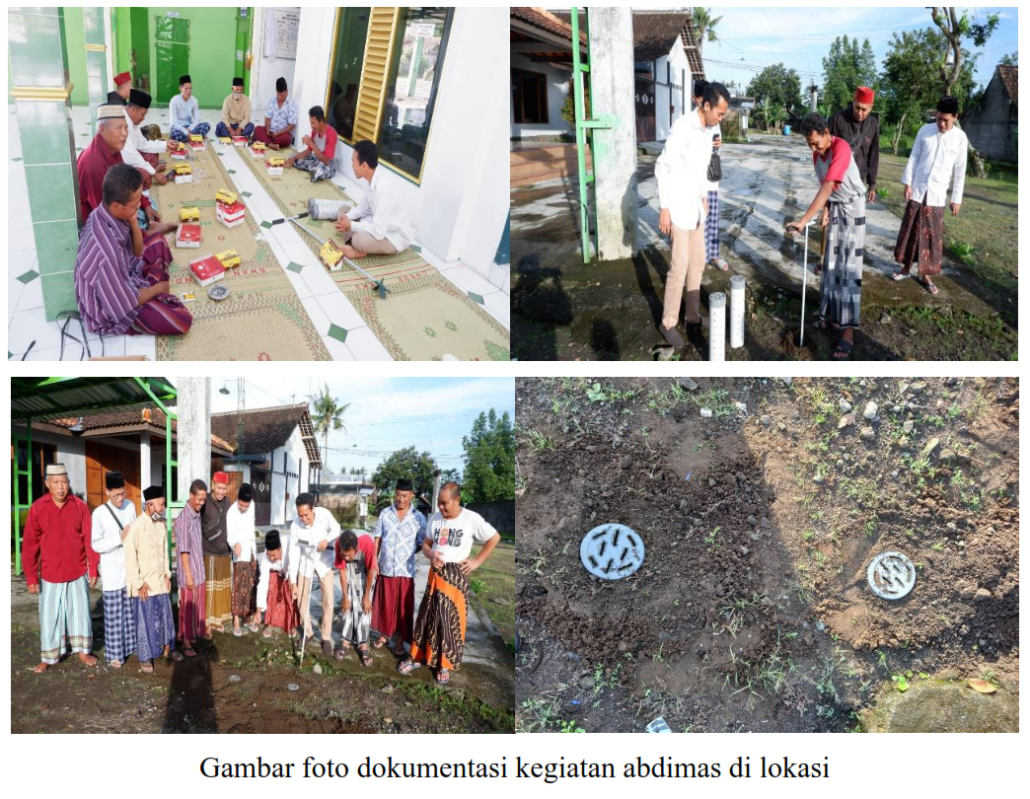
The community service activities carried out in the area showed high community enthusiasm for implementing and diffusing the biopore infiltration hole technology. The community fully realizes that this effort is to minimize rainwater flooding in their yards and serve as a groundwater/well deposit to anticipate water scarcity in the dry season. The activities began with a training session at the mosque’s porch, attended by mosque administrators and congregants living around the mosque. The materials covered the technical concept of biopore infiltration hole diffusion, the necessary equipment, and materials, including a 1-meter-long manual soil drill shaped like a T and a 4-inch diameter PVC pipe with a perforated lid using an electric soldering iron. The next step was the practical creation of biopore infiltration holes using the equipment and materials, conducted participatorily, allowing the community to implement their knowledge with direct assistance from the facilitators.
This practical session resulted in two biopore infiltration holes, complete with perforated PVC pipes and lids ready to absorb subsequent rainwater. From these two biopore infiltration holes, it is hoped that the community can produce many more in potential flooding spots around the mosque and residential yards, allowing the technology’s benefits to be widely felt. The more infiltration holes the community has, the more abundant the groundwater deposit, achieving the Sustainable Development Goals (SDGs 2030) related to clean water access and sanitation for the community.

DAFTAR REVIEWER PENGABDIAN MASYARAKAT INTERNAL PERGURUAN TINGGI TAHUN 2023 – 2024 DIREKTORAT PENELITIAN DAN PENGABDIAN MASYARAKAT UNIVERSITAS ISLAM INDONESIA
PENGUMUMAN
No : 91/Dir.DPPM/80/DPPM/I/2023
TENTANG :
DAFTAR REVIEWER PENGABDIAN MASYARAKAT INTERNAL PERGURUAN TINGGI TAHUN 2023 – 2024 DIREKTORAT PENELITIAN DAN PENGABDIAN MASYARAKAT UNIVERSITAS ISLAM INDONESIA
Bismillahirrahmanirrahim
Setelah melalui proses pendaftaran dan penetapan reviewer pengabdian masyarakat internal perguruan tinggi, maka bersama ini kami sampaikan daftar nama reviewer pengabdian masyarakat internal perguruan tinggi tahun 2023 – 2024. Adapun daftar nama reviewer pengabdian masyarakat internal perguruan tinggi terlampir sebagai berikut.
Demikian pengumuman ini kami sampaikan, atas perhatiannya kami ucapkan terima kasih.
Billahi Taufiq Wal Hidayah
Yogyakarta, 24 Januari 2023
Direktur DPPM,
Ttd
Eko Siswoyo, S.T., M.Sc.ES., Ph.D
Lampiran Surat Nomor: No : 91/Dir.DPPM/80/DPPM/I/2023
No
Fakultas
DAFTAR REVIEWER PENELITIAN INTERNAL PERGURUAN TINGGI TAHUN 2023 – 2024 DIREKTORAT PENELITIAN DAN PENGABDIAN MASYARAKAT UNIVERSITAS ISLAM INDONESIA
PENGUMUMAN
No : 90/Dir.DPPM/70/DPPM/I/2023
TENTANG :
DAFTAR REVIEWER PENELITIAN INTERNAL PERGURUAN TINGGI TAHUN 2023 – 2024
DIREKTORAT PENELITIAN DAN PENGABDIAN MASYARAKAT UNIVERSITAS ISLAM INDONESIA
Bismillahirrahmanirrahim
Setelah melalui proses pendaftaran dan penetapan reviewer penelitian internal perguruan tinggi, maka bersama ini kami sampaikan daftar nama reviewer penelitian internal perguruan tinggi tahun 2023 – 2024. Adapun daftar nama reviewer penelitian internal perguruan tinggi terlampir sebagai berikut.
Demikian pengumuman ini kami sampaikan, atas perhatiannya kami ucapkan terima kasih.
Billahi Taufiq Wal Hidayah
Yogyakarta, 24 Januari 2023
Direktur DPPM,
Ttd
Eko Siswoyo, S.T., M.Sc.ES., Ph.D
Lampiran Surat Nomor: 90/Dir.DPPM/70/DPPM/I/2023
No
Fakultas
PENDAMPINGAN DIFUSI LUBANG RESAPAN BIOPORI: Mengurangi Genangan Air Hujan dan Antisipasi Kelangkaan Air Bersih di Musim Kemarau
Persoalan genangan air hujan yang terlalu lama di halaman rumah masyarakat tidak dapat dipandang remeh mengingat mikroba patogen dan jamur serta virus dapat berkembang biak sehingga menimbulkan beragam penyakit, mulai dari penyakit kulit sampaia penyakit pencernaan (diare, disentri, dll). Ditambah minimnya resapan air di ruas-ruas ruang terbuka di kawasan tersebut semakin memperparah dampak limpasan air hujan yang ditimbulkan. Akibatnya adalah setiap musim kemarau panjang terjadi kelangkaan air sumur warga sehingga persoalan kesehatan sanitasi muncul dan dampaknya adalah timbulnya penyakit. Akses air bersih bagi masyarakat sangat urgen mengingat air bersih sangat diperlukan untuk kegiatan memasak, minum, mandi dan bersuci/wudhu, sehingga jika air bersih ini berkurang/langka maka kesehatan masyarakat pasti merosot dan penyakit bermunculan. Dalam rangka memberi solusi bagi persoalan lingkungan dan kesehatan masyarakat sekitar kompleks masjid tersebut maka diusulkan program abdimas berjudul “DIFUSI TEKNOLOGI LUBANG RESAPAN BIOPORI: Penyimpanan Air Hujan di dalam Tanah untuk Antisipasi Kelangkaan Air Sumur Warga Masyarakat Komplek Masjid Al-Muhajirin, Tiyasan, Kelurahan Condongcatur, Kecamatan Depok, Sleman, D.I.Yogyakarta”. dengan pemateri Feris Firdaus, M.Si selaku dosen Jurusan Teknik Industri Universitas Islam Indonesia, Melalui program ini diharapkan genangan air saat hujan dapat terkurangi dan tabungan air di dalam tanah meningkat sehingga saat musim kemarau tidak terjadi kelangkaan air sumur warga.
Hasil kegiatan pengabdian masyarakat yang sudah dilakukan di lokasi tersebut menunjukkan bahwa masyarakat sangat antusias dalam implementasi dan difusi teknologi lubang resapan biopori tersebut. Sepenuhnya masyarakat menyadari bahwa upaya yang dilakukan ini adalah dalam rangka meminimalisasi genangan air hujan di halaman rumah masing-masing di Kawasan Komplek Masjid Al-Muhajirin dan sekaligus sebagai tabungan/deposit air tanah/sumur untuk antisipasi kelangkaan air di musim kemarau. Kegiatan pengabdian masyarakat ini dimulai dengan tahapan pelatihan di serambi masjid yang diikuti oleh takmir masjid dan jama’ah masjid yang tinggal di sekitar kawasan masjid. Materi yang disampaikan berupa konsep teknis difusi teknologi lubang resapan biopori berikut peralatan dan bahan yang diperlukan yakni alat bor tanah secara manual berbentuk T dengan ukuran panjang 1 m dan pipa PVC dengan ukuran diameter 4 inch beserta penutupnya yang sudah dilubangi menggunakan alat solder listrik. Tahapan berikutnya adalah praktik pembuatan lubang resapan biopori menggunakan alat adan bahan tersebut yang dilakukan secara pasrtisipatori yakni berdasarkan hasil pelatihan lantas masyarakat dapat mengimplementasikan pengetahuannya untuk membuat lubang resapan biopori yang didampingi pengabdi secara langsung.
Pada tahapan praktik ini dihasilkan produk percontohan lubang resapan biopori sebanyak 2 lubang resapan lengkap dengan 2 pipa PVC yang sudah dilubangi beserta tutupnya yang sudah siap meresapkan air hujan yang turun kemudian. Berangkat dari 2 produk teknologi lubang resapan yang sudah dibuat ini, diharapkan masyarakat tersebut dapat memproduksi banyak lubang resapan di beberapa titik potensial terjadi genanangan air hujan di kawasan masjid dan halaman rumah masing-masing masyarakat sehingga manfaat dari difusi teknologi ini dapat dirasakan secara meluas. Berangkat dari 2 produk teknologi lubang resapan yang sudah dibuat ini, diharapkan masyarakat tersebut dapat memproduksi banyak lubang resapan di beberapa titik potensial terjadi genanangan air hujan di kawasan masjid dan halaman rumah masing-masing masyarakat sehingga manfaat dari difusi teknologi ini dapat dirasakan secara meluas. Semakin banyak lubang resapan yang dimiliki warga masyarakat, diharapkan deposit air tanah semakin melimpah sehingga tujuan pembangunan berkelanjutan (SDGs 2030) yang berkaitan dengan akses air bersih dan sanitasi bagi masyarakat dapat tercapai.
ASSISTANCE IN THE DIFFUSION OF BIOPORE INFILTRATION HOLES: Reducing Rainwater Flooding and Anticipating Clean Water Scarcity in the Dry Season
(Sleman 9/1) – Referring to the report by the Meteorology, Climatology, and Geophysics Agency (BMKG) of D.I. Yogyakarta, the rainy season began in October, with the peak expected in December 2022, January 2023, and February 2023, generally predicted to peak in February 2023 (Karnawati, 2022). The high rainfall has led to rainwater flooding in the Al-Muhajirin Mosque Complex area, Tiyasan, Condongcatur Village, Depok District, Sleman, D.I. Yogyakarta. This flooding is caused by the high and evenly distributed rainfall intensity in Sleman. Additionally, the concrete paving of village roads and residential yards in recent years, unsupported by adequate rainwater runoff drainage, exacerbates the flooding.
Rainwater flooding in residential yards cannot be underestimated, as pathogenic microbes, fungi, and viruses can proliferate, causing various diseases from skin ailments to gastrointestinal illnesses (diarrhea, dysentery, etc.). Furthermore, the lack of water absorption in the open spaces of the area worsens the impact of rainwater runoff. Consequently, during long dry seasons, there is a scarcity of well water, leading to sanitation health issues and the emergence of diseases. Clean water access is urgent, as it is needed for cooking, drinking, bathing, and ablution. If clean water becomes scarce, public health deteriorates, and diseases emerge. To address the environmental and health issues around the mosque complex, a community service program titled “DIFFUSION OF BIOPORE INFILTRATION HOLE TECHNOLOGY: Rainwater Storage in the Ground to Anticipate Well Water Scarcity for Al-Muhajirin Mosque Complex Residents, Tiyasan, Condongcatur Village, Depok District, Sleman, D.I. Yogyakarta” was proposed, with presenter Feris Firdaus, M.Sc., a lecturer in the Industrial Engineering Department at Universitas Islam Indonesia. This program aims to reduce rainwater flooding and increase groundwater storage, preventing well water scarcity during the dry season.
The community service activities carried out in the area showed high community enthusiasm for implementing and diffusing the biopore infiltration hole technology. The community fully realizes that this effort is to minimize rainwater flooding in their yards and serve as a groundwater/well deposit to anticipate water scarcity in the dry season. The activities began with a training session at the mosque’s porch, attended by mosque administrators and congregants living around the mosque. The materials covered the technical concept of biopore infiltration hole diffusion, the necessary equipment, and materials, including a 1-meter-long manual soil drill shaped like a T and a 4-inch diameter PVC pipe with a perforated lid using an electric soldering iron. The next step was the practical creation of biopore infiltration holes using the equipment and materials, conducted participatorily, allowing the community to implement their knowledge with direct assistance from the facilitators.
This practical session resulted in two biopore infiltration holes, complete with perforated PVC pipes and lids ready to absorb subsequent rainwater. From these two biopore infiltration holes, it is hoped that the community can produce many more in potential flooding spots around the mosque and residential yards, allowing the technology’s benefits to be widely felt. The more infiltration holes the community has, the more abundant the groundwater deposit, achieving the Sustainable Development Goals (SDGs 2030) related to clean water access and sanitation for the community.
Materi Workshop Strategi meraih pendanaan kedaireka
JADWAL PRA PELAKSANAAN KKN UII ANGKATAN 66 SEMESTER GENAP TA 2022/2023
PENGUMUMAN
Nomor: /DirDPPM/80/DPPM/XII/2022
Tentang
JADWAL PRA PELAKSANAAN KKN UII
ANGKATAN 66 SEMESTER GENAP TA 2022/2023
Diumumkan bagi mahasiswa peserta KKN UII Angkatan 66 Semester Genap Tahun Akademik 2022/2023 diharapkan memperhatikan dan wajib mengikuti jadwal kegiatan pelaksanaan KKN sebagai berikut:
No
Keterangan
Pkl 15.00 WIB
Pkl 15.00 WIB
Pkl 15.00 WIB
Pkl 08.30 s/d 11.00 WIB
Pkl 08.30 s/d 11.00 WIB
Jam 09.00 sd 12.00 WIB
Jam 13.00 sd 15.00 WIB
Jam 09.00 sd 12.00 WIB
Jam 13.00 sd 15.00 WIB
Jam 09.00 sd 12.00 WIB
Jam 13.00 sd 15.00 WIB
Jam 09.00 sd 12.00 WIB
Jam 13.00 sd 15.00 WIB
Pukul 07.00 WIB
Di lokasi masing-masing
Demikian, untuk menjadi perhatian.
Yogyakarta, 16 Desember 2022
Direktur DPPM UII
Ttd
Eko Siswoyo, S.T., M.Sc.ES., Ph.D.
Rekruitmen Reviewer Internal Pengabdian Masyarakat Universitas Islam Indonesia
Rekruitmen Reviewer Internal Penelitian Universitas Islam Indonesia
Call For Research Collaborations 2023 – Badan Riset dan Innovasi Nasional (BRIN)
Extension of the Upload Period of the Final Report of the Research and Community Service Program for the 2022 Fiscal Year